Akademische Wissenschaftliche Zeitschriften
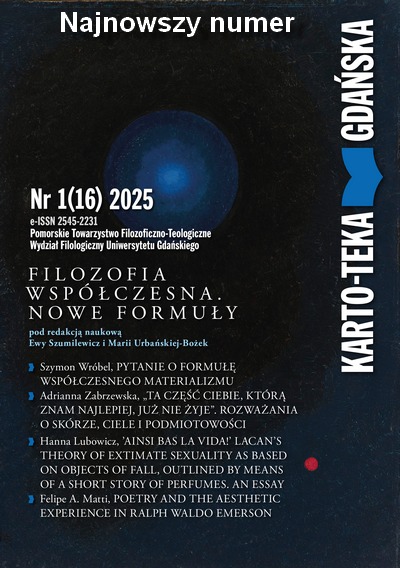
Poetry and the aesthetic experience in Ralph Waldo Emerson
DOI:
https://doi.org/10.26881/kg.2025.1.05Schlagworte:
Emerson, Poetry, Nature, Beauty, AestheticsAbstract
This paper explores the intricate relationship between beauty and aesthetic experience in poetry, centring on R.W. Emerson’s The Rhodora. It argues that poetry is an act of metamorphosis, through which the poet returns to and becomes part of Nature, a dynamic process of becoming, a dramatization of the soul that animates it. The poet, attuned to this movement, places themselves within Nature’s stream of wisdom and power, allowing beauty to emerge through poetic expression. Therefore, poetry is not merely composed and read; it is recited, sung, and proclaimed as a reaffirmation of life itself. The poet’s task is to bridge the sensual and the ineffable, expressing the infinite through symbols. Poetry combats intellect’s tendency toward abstraction, restoring the unity of experience by revealing that every end in Nature is a new beginning. In this way, poetry, like Nature, enlivens the intellect and unveils truth. It neither detaches nor aggregates but instead operates with a vigilant integrity, mirroring the wholeness of Nature itself. Ultimately, poetry speaks of beauty, awakening the mind through its transformative power.
Downloads
Literaturhinweise
Brown, P. W., Emerson’s philosophy of aesthetics, “The Journal of Aesthetics and Art. Criticism” 1957, No. 15(3), p. 350–354.
Brown, T. M., Greenough, Paine, Emerson, and the Organic Aesthetic. The Journal of Aesthetics and Art Criticism” 1956, No. 14(3), p. 304–317.
Downard, J., Emerson’s experimental ethics and Kant’s analysis of beauty, Transactions of the Charles S. Peirce Society” 2003, No. 39(1), p. 87–112.
Emerson, R. W., The complete works of Ralph Waldo Emerson, vol. I–III and VII, The Riverside Press Cambridge 1903.
Emerson, R. W., Complete works (Available online at https://emersoncentral.com/texts – last time accessed March 21st 2024)
Guardiano, N., Aesthetic transcendentalism in Emerson, Peirce, and nineteenth-century American landscape painting, Bloomsbury Publishing PLC 2016.
Harvey, S. C., Transatlantic Transcendentalism: Coleridge, Emerson and Nature, Edinburgh University Press 2013.
Hopkins, V., Spires of form: a study of Emerson’s aesthetic theory, Harvard University Press 1951.
Kant, I., Gesammelte Schriften, Bd. 1–22, Preussische Akademie der Wissenschaften, Bd. 23: Deutsche Akademie der Wissenschaften zu Berlin, ab Bd. 24: Akademie der Wissenschaften zu Göttingen, 1900s.
Kant, I., Critique of the power of judgement, trans. P. Guyer, E. Matthews, Cambridge University Press 2000.
Michaud, R., Emerson’s transcendentalism. “The American Journal of Psychology” 1919, 30(1), p. 73–82.
Myerson, J. (ed.), Transcendentalism: a reader, Oxford University Press 2000.
Reynolds L. J., Lynch T. E., Sense and Transcendence Emerson, Thoreau, and Whitman, “The South Central Bulletin” 1979, Vol. 39, No. 4, p. 148–15151.
Richardson, R., Emerson: the mind on fire, California University Press 1995.
Richardson, R., “Emerson and Nature”, in: J. Porte, S. Morris (eds.), (1999). The Cambridge companion to Ralph Waldo Emerson, Cambridge University Press 1999.
Riley, W., American Thought from Puritanism to Pragmatism and Beyond, New York 1915.
Shusterman, R., Emerson’s Pragmatist Aesthetics, “Revue internationale de philosophie” 1999, p. 87–99.
Wellek, R., “The minor transcendentalists and German philosophy”, “The New England Quarterly” 1942, No. 15(1), p. 652–680.
Wellek, R., Emerson and German philosophy, The New England Quarterly” 1943, No. 16(1), p. 41–62.