Academic Scientific Journals
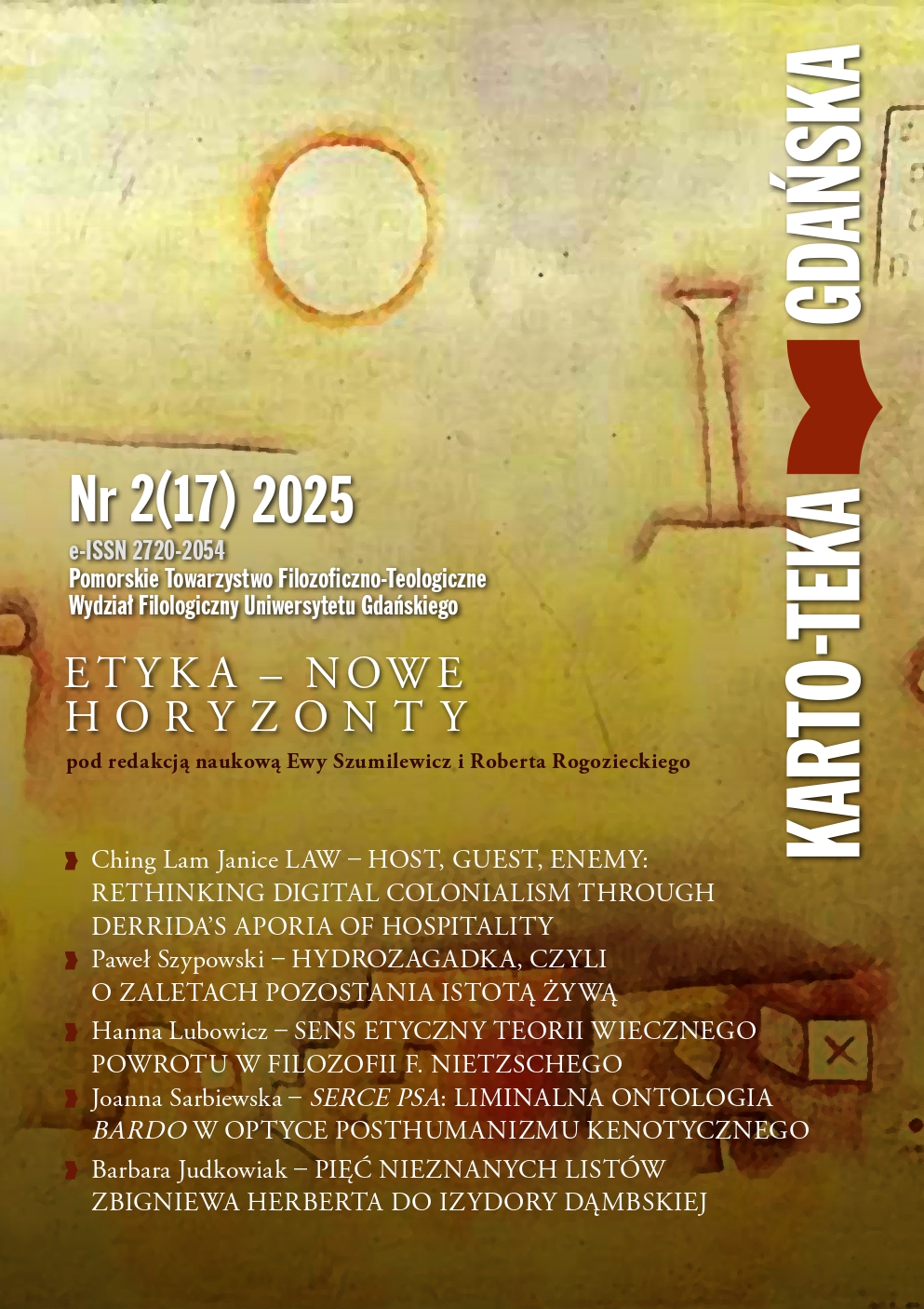
The ethical meaning of the theory of eternal return in the philosophy of F. Nietzsche
DOI:
https://doi.org/10.26881/kg.2025.2.05Keywords:
Nietzsche, eternal recurrence, ethics, will to power, resentment, affirmation, creating, freedom, therapyAbstract
The main focus of this text is these aspects of Nietzsche’s philosophy which are often neglected. This is the question of time, of one’s particular existence. Drawing upon some physical theories based on circularity of time, Nietzsche formulates the concept „eternal recurrence”, and gives on it a strictly ethical meaning. The main assumption is: if time is circulating infinitely, and things keep repeating to be the same every time: would we make the same choices as what we have already made. Here, everything is based on the notion of time, which can be considered as axiom. It might be compared to Kant’s imperative categorical that takes the formula of a law. As such, it is based on pure reason or a practical reason. However, in order to respect Nietzsche’s command, you need more human, multifaceted rationality. According to it, something more is needed, not to just endure that which is inevitable, not to just tolerate it, but to repeat, desire and love it, for the infinite number of times. The ethical ideal is amor fati. Amor fati has a strong volitional, affective and emotional component. It’s a personal choice, taking account his whole existence. First of all, love of fate doesn’t implicate any contempt for the „lower”, any disdain for „weakness”, any denigrating or rejecting. Rather: acceptance for the feeble ones and trying to change it for the better. Übermensch is first of all a sage, a wise, experienced man, that teaches the distinction between the changeable and unchangeable and wants his student to have a strong power of will. The institution of Übermensch is very hard to bear, there aren’t many who can sustain it. The Nietzschean ideal is that every human being can in fact become it, if he’s able to embrace the crucial question with love and certitude. This can be called a truly existential criterion of ethical life, the always particular one, as there are not a univocal, universal form of morality for anyone.
Downloads
References
TEKSTY ŹRÓDŁOWE
Nietzsche F., Dusza dostojna, Rękodzielnia Arhat, Wrocław 2001.
Nietzsche F., Ecce homo, Wydawnictwo Bellona, Warszawa 2024.
Nietzsche F., Ludzkie, arcyludzkie, Vis-a-Vis Etiuda, Kraków 2016.
Nietzsche F., Narodziny tragedii, Wydawnictwo Zielona Sowa, Kraków 2000.
Nietzsche F., Pisma pozostałe 1862–1875, Inter esse, Kraków 1993.
Nietzsche F., Tako rzecze Zaratustra, Zysk i S-ka, Poznań 2000.
Nietzsche F., Wola mocy, Wydawnictwo Zielona Sowa, Kraków 2003.
Nietzsche F., Wiedza radosna, Wydawnictwo Zielona Sowa, Kraków 2000.
Nietzsche F., Z genealogii moralności, Wydawnictwo Zielona Sowa, Kraków 2003.
LITERATURA POZOSTAŁA
Ansell-Pearson K., A Companion to Nietzsche, Wiley Blackwell, Oxford 2008.
Ansell-Pearson K., An Introduction to Nietzsche as Political Thinker, Cambridge University Press, Cambridge 2009.
Ansell-Pearson K., How to Read Nietzsche, W. W. Norton & Co., New York 2005.
Ansell-Pearson K., Nietzsche Contra Rousseau, Cambridge University Press, Cambridge 1996.
Ansell-Pearson K., Nietzsche’s Earthbound Wisdom: The Philosopher, the Poet, and the Sage, The University of Chicago Press, Chicago 2025.
Ansell-Pearson K., Nietzsche’s Search for Philosophy: On the Middle Writings, Bloomsbury Publishing, London 2018.
Ansell-Pearson K., Viroid Life: Perspectives on Nietzsche and the Transhuman Condition, Routledge, New York 1997.
Buber M., Ja i Ty. Wybór pism filozoficznych, Instytut Wydawniczy PAX, Kraków 1992.
Deleuze G., Nietzsche a filozofia, Wydawnictwo Spacja, Warszawa 1993.
Deleuze G., Różnica i powtórzenie, Wydawnictwo KR, Warszawa 1997.
Derrida J., Χώρᾱ / Chora, Wydawnictwo KR, Warszawa 1999.
Derrida J., Marginesy filozofii, Wydawnictwo KR, Warszawa 1992.
Derrida J., O gramatologii, Wydawnictwo KR, Warszawa 1999.
Derrida J., Ostrogi. Style Nietzschego, Oficyna, Łódź 2012.
Foucault M., On the Government of the Living: Lectures at the Collège de France, 1979–1980, Palgrave Macmillan, London 2014.
Foucault M., The Courage of Truth, Palgrave Macmillan, London 2011.
Górczyńska K., Podmiot jako byt otwarty. Problematyka podmiotowości w późnych pismach Wittgensteina, Wydawnictwo UMCS, Lublin 2007.
Hadot P., Filozofia jako ćwiczenie duchowe, Instytut Filozofii i Socjologii PAN, Warszawa 1992.
Hatab L., Nietzsche’s Life Sentence: Coming to Terms with Eternal Recurrence, Routledge, New York 2005.
Hegel G. W. F., Nauka logiki, t. 1–2, Wydawnictwo Naukowe PWN, Warszawa 2011.
Heidegger M., Nietzsche, t. 1–2, PWN, Warszawa 1998.
Klossowski P., Nietzsche i błędne koło, Wydawnictwo KR, Warszawa 1996.
Klossowski P., Nietzsche, politeizm i parodia, Colloquia Communia, Warszawa 1988.
Lacan J., Écrits, W. W. Norton & Co., New York 2007.
Lacan J., Introduction à la topologie des formations de l’inconscient, Éditions du Seuil, Paris 1970.
Lear J., Nadzieja radykalna. Etyka wobec spustoszenia kulturowego, Wydawnictwo Naukowe PWN, Warszawa 2013.
Leder A., Rysa na tafli. Teoria w polu psychoanalitycznym, Wydawnictwo Naukowe PWN, Warszawa 2016.
Lévinas E., Całość i nieskończoność. Esej o zewnętrzności, Wydawnictwo Naukowe PWN, Warszawa 1998.
Lorenc W., W miejsce religii. Ku filozofii nadziei radykalnej, Wydawnictwa UW, Warszawa 2021.
Nehamas A., Nietzsche: Life as Literature, Harvard University Press, Cambridge 1987.
Pieniążek P., Brzozowski. Wokół kultury: inspiracje Nietzscheańskie, Wydawnictwo IFiS PAN, Warszawa 2004.
Pieniążek P., Rozum i szaleństwo: nowe francuskie interpretacje myśli Nietzschego, Wydawnictwo KR, Warszawa 1996.
Rosińska Z., Psychoterapia i kultura. Celebracja urazu czy leczenie duszy, Wydział Filozofii i Socjologii UW, Warszawa 1997.
Szumilewicz E., On the Paradox of Cognition, Peter Lang, Berlin 2021.
Taleb N., Czarny łabędź. Jak nieprzewidywalne zdarzenia rządzą naszym życiem, Zysk i S-ka, Poznań 2020.
Taleb N., Antykruchość. Jak żyć w świecie, którego nie rozumiemy, Zysk i S-ka, Poznań 2020.
Young J., Nietzsche’s Philosophy of Art, Cambridge University Press, Cambridge 2009.
Young J., Nietzsche’s Philosophy of Religion, Cambridge University Press, Cambridge 2009.
Yalom I., Kiedy Nietzsche szlochał, Instytut Psychologii Zdrowia PTP, Warszawa 2005.
Yalom I., Kuracja według Schopenhauera, Instytut Psychologii Zdrowia PTP, Warszawa 2006.
Yalom I., Problem Spinozy, Wydawnictwo Zielone Drzewo, Warszawa 2005.
Żelazny M., Wieczny powrót i wieczne powracanie w filozofii Fryderyka Nietzschego, Studia Filozoficzne, Warszawa 1982.