Uniwersyteckie Czasopisma Naukowe
Skeumorfizm w bursztyniarstwie neolitycznym: naśladownictwo siekier i toporów
DOI:
https://doi.org/10.26881/porta.2024.23.02%20Słowa kluczowe:
bursztyn, Bałtyk, Neolit, siekiera, topór, kamień, krzemień, miedźAbstrakt
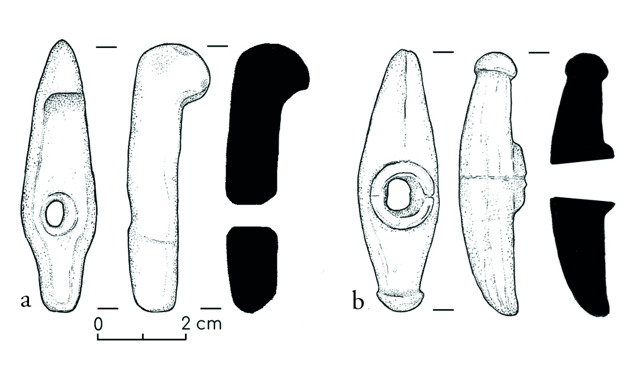
Wśród wyrobów bursztynowych wywodzących się z neolitu (ok. 4000−1750 p.n.e.) w zachodniej i południowej części basenu Morza Bałtyckiego można znaleźć imitacje siekier i toporów w tamtym okresie wytwarzanych w krzemienia i kamienia, a czasem także miedzi. Stylistyka bursztyniarska oparta na naśladownictwie wytworów rąk ludzkich stanowi całkowity zwrot w stosunku do sztuki mezolitu (ok. IX–V tysiąclecie p.n.e.), kiedy to głównie przedstawiano w bursztynie przyrodę – zwierzęta. Skeumorfy siekier i toporów wykonane w bursztynie pojawiają się począwszy od ok. 3300 p.n.e. w kulturach pucharów lejkowatych, amfor kulistych, ceramiki sznurowej i toporów bojowych, każdorazowo wiernie odzwierciedlając kształt ich kamiennych i krzemiennych odpowiedników właściwych tym kulturom. Mają jednak mniejsze rozmiary i perforacje umożliwiające ich noszenie jako ozdób, np. paciorków w naszyjniku czy zawieszek. Ze względu na te cechy oraz właściwości surowca, z którego zostały wykonane – bursztynu, nie mogły one pełnić funkcji utylitarnych, tak jak siekiery i topory kamienne lub krzemienne.
Rola tych bursztynowych przedmiotów, poza zdobieniem ubioru, najpewniej sprowadzała się do symbolizowania pewnych treści kojarzonych ze wspomnianymi narzędziami, potencjalnie wykorzystywanymi również jako broń. O ile krzemienne siekiery stanowiły przedmioty codziennej pracy, które ze względu na swoją przydatność przedstawiały zapewne dużą wartość dla neolitycznych osadników‑rolników w warunkach gęstego zalesienia północnej Europy, o tyle kamienne topory bojowe wykraczają poza sferę czysto utylitarną. Są one często zdobione, posiadają tępe ostrza nie noszące śladów użytkowania, a niewielkie otwory na rękojeści nie pozwoliłyby na ich efektywne wykorzystanie. Z tych powodów niektórzy badacze traktują je jako broń symboliczno‑paradną. Niemniej jednak znane są przykłady toporów kamiennych o mniej wyszukanej formie, które noszą ślady uszkodzeń i napraw. Niewykluczone zatem, że przedmioty te mogły być w pewnych sytuacjach wykorzystywane do pracy lub w walce, choć trudno jest określić, jak uderzenia o tkanki miękkie i kości mogłyby wpłynąć na ich ostrza.
Dane archeologiczne wskazują na kryzys, jaki miał dotknąć społeczności neolityczne w związku ze zmianami klimatycznymi pod koniec IV tysiąclecia p.n.e., czyli w okresie powstawania pierwszych bursztynowych skeumorfów. W tych warunkach mogło dochodzić do migracji, rywalizacji o ziemię i niepokojów przybierających postać konfliktów zbrojnych. Bursztyn jako substancja rzadko występująca, dodatkowo uformowana na wzór siekier i toporów tradycyjnie wykorzystywanych w określonej społeczności, mógł służyć do wyrażania tożsamości oraz identyfikacji współplemieńców. Symbolika tych przedmiotów prawdopodobnie dotykała także wierzeń, na co wskazują badania lingwistyczne wywodzące takie terminy jak „grom” i „niebo” od „zaostrzonych narzędzi z kamienia/krzemienia”. Wyobrażenia na temat kosmologii i sił rządzących światem przenikały do innych sfer życia społecznego, i poprzez swoją symbolikę siekiery i topory mogły znajdować zastosowanie wśród przedstawicieli grup dążących do władzy, np. jako insygnia czy talizmany. Jednakże trudno na obecnym etapie badań określić, czy bursztynowe paciorki oraz zawieszki w kształcie siekier i toporów spełniały tylko jedną funkcję, czy też ich symbolika oraz zakres zastosowań były szersze.
Downloads
Bibliografia
Allentoft Morten E., Sikora Martin, Fischer Andreas et al., 100 ancient genomes show repeated population turnovers in Neolithic Denmark, “Nature” 2024, vol. 625, no. 7994, pp. 329–337.
Antoniewicz Włodzimierz, Z dziedziny archeologii ziem Polski, “Światowit” 1936–1937, nr 17, pp. 341–422.
Axelsson Tony, Strinnholm Anders, The Use of Amber in the Scandinavian Stone Age [in:] From Funeral Monuments to Household Pottery: current advances in Funnel Beaker Culture (TRB/TBK) research. Proceedings of the Borger Meetings 2009, eds. Jan A. Bakker, Simone B.C. Bloo, Monica K. Dütting, Oxford 2013, pp. 143–150.
Åberg Nils, Streitäxte mit Doppeltülle, “Praehistorische Zeitschrift” 1916, Bd. 8, pp. 85–93.
Bakker Jan A., The TRB West Group. Studies in the Chronology and Geography of the Makers of Hunebeds and Tiefstich Pottery, 2nd ed., Leiden 2009.
Beran Jonas, Nackenkammäxte und A -Äxte: eine Werkstatt – zwei Auftraggeber? [in:] Varia neolithica VIII – Dechsel, Axt, Beil und Co – Werkzeug, Waffe, Kultgegenstand? – Aktuelles aus der Neolithforschung, eds. Hans Jürgen Beier, Ralph Einicke, Eric Biermann, Langenweissbach 2014, pp. 21–30.
Borkowski Wojciech, Budziszewski Janusz, The use of striped flint in prehistory, “Archaeo logia Polona” 1995, t. 33, pp. 71–87.
Boroń Tomasz, Winiarska Kabacińska Małgorzata, Flint manufacturing of the Globular Amphorae culture at the site Wilczyce 10 (Lesser Poland) in the context of inventories from the neighbouring areas, “Archeologické rozhledy” 2021, vol. 73, no. 2, pp. 163–199.
Brandt Karl Heinz, Studien über steinerne Äxte und Beile der jüngeren Steinzeit und der Stein -Kupferzeit Nordwestdeutschlands, Münstersche Beiträge zur Vor und Früh geschichte, vol. 2, Hildesheim 1967.
Brennan T. Corey, The Fasces: A History of Ancient Rome’s Most Dangerous Political Symbol, Oxford 2022.
Bronicki Andrzej, Grób kultury amfor kulistych w Kolonii Czułczyce, stan. 6, gm. Sawin, pow. Chełm, woj. Lublin, “Archeologia Polski Środkowowschodniej” 2000, t. 5, pp. 181–195.
Brozio Jan P., Stos Gale Zofia, Müller Johannes, Müller Scheeßel Nils, Schultrich Sebastian, Fritsch Barbara, Skorna Henry, The origin of Neolithic copper on the central Northern European plain and in Southern Scandinavia: Connectivities on a European scale, “PLOS ONE” 2023, vol. 18, no. 5, e0283007.
Bugajska Karolina, Obrządek pogrzebowy łowców -zbieraczy epoki kamienia w południowej Skandynawii i na Niżu Środkowoeuropejskim, “Przegląd Archeologiczny” 2014, t. 62, pp. 5–69.
Bunbury Magdalena Maria E., Austvoll Knut I., Jørgensen Erlend K., Nielsen Svein V., Kneisel Jutta, Weinelt Mara, Understanding climate resilience in Scandinavia during the Neolithic and Early Bronze Age, “Quaternary Science Reviews” 2023, vol. 322, e108391.
Butrimas Adomas, Amber discs with cross decoration in the South Eastern Baltic, Vilnius 2018.
Cwaliński Mateusz, Evolution of amber’s status and symbolism between the Neolithic and the Bronze Age: case studies from the Baltic and Adriatic Basins, “Praehistorische Zeitschrift”, in print. Czebreszuk Janusz, Amber on the Threshold of a World Career [in:] Amber in Archaeology. Proceedings of the Fourth International Conference on Amber in Archaeology, Talsi 2001, eds. Curt W. Beck, Ilze B. Loze, Joan M. Todd, Riga 2003, pp. 164–179.
Czebreszuk Janusz, Kozłowska Skoczka Dorota, Sztylety krzemienne na Pomorzu Zachodnim, Szczecin 2008.
De Vaan Michiel, Etymological Dictionary of Latin and the other Italic Languages, Leiden Indo European Etymological Dictionary Series, vol. 7, Leiden–Boston 2008.
Dörfler Walter, Dreibrodt Stefan, Eriksen Berit V., Feeser Ingo, Groß Daniel, Hofmann Robert, Ribeiro Artur, Schlütz Frank, Wieckowska Lüth Magdalena, Wild Markus, Creation of Cultural Landscapes – Decision-Making and Perception Within Specific Ecological Settings [in:] Perspectives on Socio-environmental Transformations in Ancient Europe, eds. Johannes Müller, Wiebke Kirleis, Nicole Taylor, Cham 2024, pp. 177–220.
Dörfler Walter, Feeser Ingo, Hildebrandt Radke Iwona, Rzodkiewicz Monika, Environment and settlement – A multiproxy record of holocene palaeoenvironmental development from Lake Wonieść, Greater Poland, “Vegetation History and Archaeobotany” 2023, vol. 32, no. 2, pp. 187–204.
Dumézil Georges, Gods of the Ancient Northmen, Berkeley–Los Angeles–London 1973.
Ebbesen Klaus, Die jüngere Trichterbecherkultur auf den dänischen Inseln, Arkæologiske Studier. Herausgegeben vom Institut für Prähistorische Archäologie der Universität Kopenhagen, vol. 2, Kopenhagen 1975.
Ebbesen Klaus, Die nordischen Bernsteinhorte der Trichterbecherkultur, “Praehistorische Zeitschrift” 1995, Bd. 70, H. 1, pp. 32–89.
Feeser Ingo, Dörfler Walter, Kneisel Jutta, Hinz Martin, Dreibrodt Stefan, Human impact and population dynamics in the Neolithic and Bronze Age: Multi -proxy evidence from north -western Central Europe, “The Holocene” 2019, vol. 29, no. 10, pp. 1596–1606.
Furholt Martin, Mobility and Social Change: Understanding the European Neolithic Period after the Archaeogenetic Revolution, “Journal of Archaeological Research” 2021, vol. 29, no. 4, pp. 481–535.
Gron Kurt J., Sørensen Lasse, Cultural and economic negotiation: a new perspective on the Neolithic Transition of Southern Scandinavia, “Antiquity” 2018, vol. 92, no. 364, pp. 958–974.
Gula Małgorzata, Bursztynowa plastyka figuralna epoki kamienia w Polsce, “Archeologia Polski” 1977, t. XXII, nr 2, pp. 369–387.
Haysom Matthew, The double-axe: a contextual approach to the understanding of a Cretan symbol in the Neopalatial period, “Oxford Journal of Archaeology” 2010, vol. 29, no. 1, pp. 35–55.
Horn Christian, Trouble in Paradise? – Violent Conflict in Funnel -Beaker Societies, “Oxford Journal of Archaeology” 2021, vol. 40, no. 1, pp. 43–64.
Iversen Rune, Big -Men and Small Chiefs: The Creation of Bronze Age Societies, “Open Archaeology” 2017, vol. 3, no. 1, pp. 361–375.
Kirleis Wiebke, Fischer Elske, Neolithic cultivation of tetraploid free threshing wheat in Denmark and Northern Germany: implications for crop diversity and societal dynamics of the Funnel Beaker Culture, “Vegetation History and Archaeobotany” 2014, vol. 23, no. S1, pp. 81–96.
Klassen Lutz, Frühes Kupfer im Norden: Untersuchungen zu Chronologie, Herkunft und Bedeutung der Kupferfunde der Nordgruppe der Trichterbecherkultur, Aarhus 2000.
Larsson Lars, The Sun from the Sea – amber in the Mesolithic and Neolithic of Southern Scandinavia [in:] Baltic Amber. Proceedings of the International Interdisciplinary Conference “Baltic amber in the natural sciences, archaeology and applied arts”, 13–18 September 2001, Vilnius, Palanga, Nida, ed. Adomas Butrimas, Vilnius 2001, pp. 65–75.
Larsson Lars, A miniature in amber of a battleaxe from the Battle -Axe Culture, “Adoranten” 2017, vol. 1, pp. 48–54.
Libera Jerzy, Sobieraj Jarosław, Topory kamienne jako identyfikatory kultury ceramiki sznurowej w środkowej i północnej części Lubelszczyzny [in:] Schyłek neolitu na Wyżynie Lubelskiej, eds. Paweł Jarosz, Jerzy Libera, Piotr Włodarczak, Kraków 2016, pp. 411–454.
Maher J. Peter, *H’aeḱ mon: “(stone) axe” and “sky” in I -E/Battle -Axe culture [in:] Papers on language theory and history I: creation and tradition in language, Amsterdam Studies in the Theory and History of Linguistic Science, ser. IV, vol. 3, ed. Ernst Frideryk K. Koerner, Amsterdam 1977, pp. 85–106.
Manasterski Dariusz, Kwiatkowska Katarzyna, Wyroby bursztynowe jako jeden z wyznaczników prestiżu „elit” na przełomie neolitu i epoki brązu na rubieży nizin środkowo - i wschodnioeuropejskiej, “Studia i materiały do badań nad neolitem i wczesną epoką brązu na Mazowszu i Podlasiu” 2015, t. V, pp. 87–111.
Mazurowski Ryszard F., Bursztyn w epoce kamienia na ziemiach polskich, “Materiały Starożytne i Wczesnośredniowieczne” 1983, t. V, pp. 7–130.
Mączyński Piotr, Flint products from a Globular Amphora culture grave in Stefankowice - Kolonia, Hrubieszów District, site 33 in the light of the latest considerations, “Sprawozdania Archeologiczne” 2022, t. 74, nr 1, pp. 441–457.
Midgley Magdalena S., TRB Culture: The First Farmers of the North European Plain, Edinburgh 1992.
Montelius Oscar, The Sun -God’s Axe and Thor’s Hammer, “Folklore” 1910, vol. 21, no. 1, pp. 60–78.
Müller Johannes, Funnel Beaker Societies and Long -Distance Trade [in:] Trade before Civilization, eds. Johan Ling, Richard Chacon, Kristian Kristiansen, Cambridge 2022, pp. 23–39.
Müller Johannes, Separation, hybridisation, and networks. Globular Amphora sedentary pastoralists ca. 3200–2700 BCE, Scales of Transformation in Prehistoric and Archaic Societies, vol. 17, Leiden 2023.
Pedersen Hilthart, Sozialarchäologische Analysen zur Kontinuität des neolithischen Bestattungsrituals Südskandinaviens. Versuch einer Analyse zur Sozialstruktur des Neolithikums auf der Grundlage von Bernstein und Nachnutzungen, M.A. thesis, Christian Albrechts Universität zu Kiel, Kiel 2008.
Peter Pétrequin, Serge Cassen, Michel Errera, Lutz Klassen, Alison Sheridan, Des choses sacrées… fonctions idéelles des jades alpins en Europe occidentale [in:] Jade. Grandes Haches Alpinesdu Néolithique Européen. Ve et IVe Millénaires av. J. -C., Presses Universitaires de Franche Comté et Centre de Recherche Archéologique de la Vallée de l’Ain, vol. 2, eds. Peter Pétrequin, Serge Cassen, Michel Errera, Lutz Klassen, Alison Sheridan, Anne Marie Pétrequin, Besançon 2012, pp. 1354–1423.
Płonka Tomasz, The Portable Art of Mesolithic Europe, Wrocław 2003.
Popkiewicz Eryk, Rekonstrukcje narzędzi, technik i technologii obróbki bursztynu z epoki kamienia, “Prace Muzeum Ziemi” 2012, nr 50, pp. 91–99.
Ramstad Morten, Axelsson Tony, Strinnholm Anders, Amber [in:] The Oxford Handbook of Neolithic Europe, eds. Chris Fowler, Jan Harding, Daniela Hofmann, Oxford 2015, pp. 657–672.
Rigaud Solange, d’Errico Francesco, Vanhaeren Marian, Ornaments Reveal Resistance of North European Cultures to the Spread of Farming, “PLOS ONE” 2015, vol. 10, no. 4, e0121166.
Rösch Manfred, Biester Harald, Bogenrieder Arno, Eckmeier Eileen, Ehrmann Otto, Gerlach Renate, Hall Mathias, Hartkopf Fröder Christoph, Herrmann Ludger, Kury Birgit, Lechterbeck Jutta, Schier Wolfram, Schulz Erhard, Late Neolithic Agriculture in Temperate Europe—A Long -Term Experimental Approach, “Land” 2017, vol. 6, no. 1, pp. 1–17.
Roy Amber S., Direct analysis of ground stone artefacts; a study of the use of Early Bronze Age Stone Battle -Axes and Axe -Hammers, “Journal of Archaeological Science: Reports” 2022, vol. 46, e103646.
Schultrich Sebastian, Neolithic Battle Axes with Cup Marks, “Proceedings of the Prehistoric Society” 2024, vol. 90, pp. 1−28.
Shennan Stephen, Exchange and ranking: the role of amber in the earlier Bronze Age [in:] Ranking, resources, and exchange, eds. Colin Renfrew, John Cherry, Cambridge 1982, pp. 137–148.
Siemen Palle, Single Grave Culture Amber from Jutland, “Fontes Archaeologici Posnani enses” 2016, vol. 52, pp. 13–40.
Skorna Henry, The Life and Journey of Neolithic Copper Objects. Transformations of the Neuenkirchen Hoard, North -East Germany (3800 BCE), Scales of Transformation, vol. 15. Leiden 2022.
Sørensen Lasse, From hunter to farmer in Northern Europe. Migration and adaptation during the Neolithic and Bronze Age, Acta Archaeologica, vol. 1–2, Oxford 2014.
Šturms Eduard, Die neolithische Plastik im nordischen Kulturkreis, “Jahrbuch Des Römisch Germanischen Zentralmuseums Mainz” 1955, Bd. 2, pp. 21–26.
Szmyt Marzena, Collective graves, flint axes, and cows. The people of Globular Amphora culture on the Vistula and Odra [in:] The Past Societies 2. Polish lands from the first evidence of human presence to the Early Middle Ages: 5500–2000 BC, ed. Piotr Włodarczak, Warszawa 2017, pp. 211–274.
Taffinder Jackie, Stone Age gold [in:] Baltic Amber. Proceedings of the International Interdisciplinary Conference “Baltic amber in the natural sciences, archaeology and applied arts”, 13–18 September 2001, Vilnius, Palanga, Nida, ed. Adomas Butrimas, Vilnius 2001, pp. 99–107.
Turek Jan, Stone axes as tools, valuables and symbols (3300–1900 BC) [in:] Material, Virtual and Temporal Compositions: on the Relationship between Objects, ed. Dragos Gheorghiu, Oxford 2001, pp. 53–62.
Wacnik Agnieszka, Ralska Jasiewiczowa Magdalena, Madeyska Ewa, Late Glacial and Holocene history of vegetation in Gostynin area, central Poland, “Acta Palaeobotanica” 2011, t. 51, nr 2, pp. 249–278.
Westrin Thomas, Stenåldern [in:] Nordisk familjebok: Konversationslexikon och realencyklopedi, ed. Th. Westrin, vol. 26, Stockholm 1917, pp. 1281–1288.
Winther Johannsen Jens, Late Neolithic Expansion: Ancient and new traditions 2350–1700 BC, “Danish Journal of Archaeology” 2023, vol. 12, no. 1, pp. 1–22.
Woltermann Gisela, Früheste doppelaxtförmige Bernsteinperlen [in:] Durch die Zeiten... Festschr. für Albrecht Jockenhövel zum 65. Geburstag, eds. Frank Verse, Benedikt Knoche, Rahden/Westf. 2008, pp. 97–111.
Woltermann Gisela, Bernstein im archäologischen Fundmaterial. Ausgewählte Aspekte an Beispielen aus dem Mesolithikum und Frühneolithikum, “Die Kunde N. F.” 2009, Bd. 60, pp. 49–60. Woltermann Gisela, Bernstein in der norddeutschen Trichterbecherkultur, “Die Kunde N. F.” 2013, Bd. 64, pp. 171–195.
Woltermann Gisela, Die prähistorischen Bernsteinartefakte aus Deutschland vom Paläolithikum bis zur Bronzezeit. Methodische Forschungen zu Lagerstättengenese, Distributions strukturen und sozioökonomischem Kontext, Universitätsforschungen zur Prähistorischen Archäologie, vol. 260, Bonn 2016.
Zápotocký Milan, Streitäxte des mitteleuropäischen Äneolithikums, Quellen und Forschungen zur prähistorischen und provizialrömischen Archäologie, Acta humaniora, vol. 16, Weinheim 1992.