Uniwersyteckie Czasopisma Naukowe
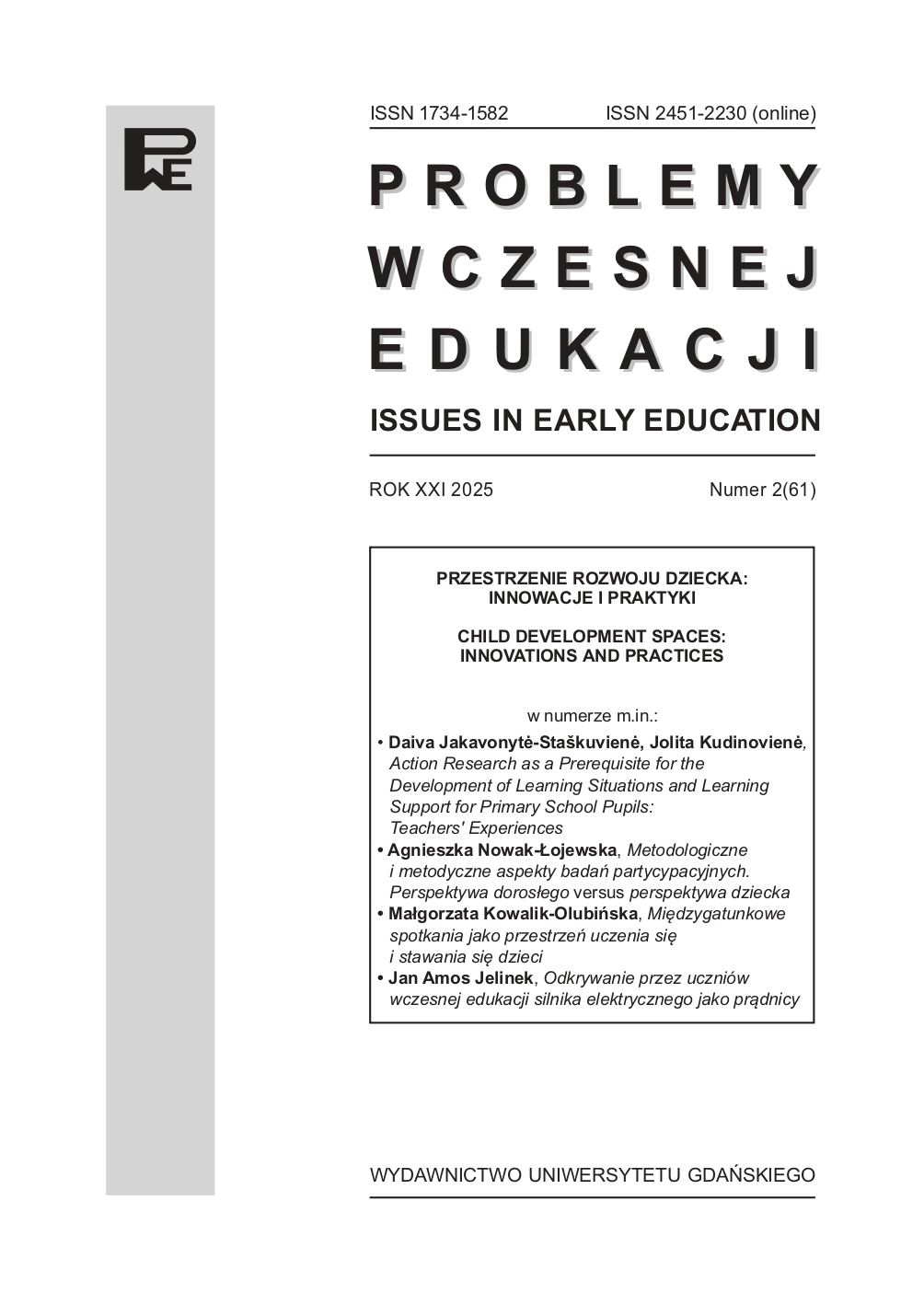
Action Research as a Prerequisite for the Development of Learning Situations and Learning Support for Primary School Pupils: Teachers’ Experiences
DOI:
https://doi.org/10.26881/pwe.2025.61.01Słowa kluczowe:
badania w działaniu, sytuacje uczenia się, wsparcie w nauce, uczniowie szkół podstawowychAbstrakt
Action research in educational practice is defined as the systematic exploration of how to change the status quo in educational practice, and how to find new ways of doing things in order to bring about positive change for all those involved in the educational process, i.e. to improve student learning and achievement. It is an activity that enables the planning of a strategy for action, which is implemented, systematically monitored, reflexively reflected upon and modified. In action research, the teacher as researcher takes on the responsibility of solving a particular learning problem, and this cannot be done without deep critical thinking abilities, which is why it is important to have deep, reflective educators in schools. Action research enhances teachers’ capacity for professional development, autonomy, and the ability to evaluate and take responsibility for educational practice and its improvement. The article presents teachers’ experiences of the value and meaning of action research in primary education practice.
Downloads
Bibliografia
Al-Huneini H., Walker S.A., Badger R. (2020), Introducing tablet computers to a rural primary school: An Activity Theory case study. “Computers & Education”, 143.
Al-Obaydi L.H., Nashruddin Rahman F.F., Suherman L.O.A. (2021), The Use of Action Research in EFL Socio-professional Context: Students-teachers’ Perceptions. “ELS Journal on Interdisciplinary Studies in Humanities”, 4(2).
Anderson G.L., Herr K., Nihlen A.S. (2007), Studying Your Own School: An Educator’s Guide to Practitioner Action Research. Thousand Oaks, CA, Corwin Press – SAGE Publications Company.
Balakrishnan V., Claiborne L. (2017), Participatory action research in culturally complex societies: opportunities and challenges. “Educational Action Research”, 25(2).
Bitinas B., Rupšienė L., Žydžiūnaitė V. (2008), Kokybinių tyrimų metodologija [Qualitative research methodology]. Vadovėlis vadybos ir administravimo studentams. Klaipėda, S. Jokužio leidykla-spaustuvė.
Bradbury H., Lewis R., Embury D.C. (2019), Education Action Research: With and for the Next Generation. In: C.A. Mertler (ed.), The Wiley Handbook of Action Research in Education. London, John Wiley & Sons.
Braun V., Clarke V. (2006), Using thematic analysis in psychology. “Qualitative Research in Psychology”, 3(2).
Burns A., Kurtoğlu-Hooton N. (2016), Using action research to explore technology in language teaching: international perspectives. London, British Council.
Cain T., Harris R. (2013), Teachers’ action research in a culture of performativity. “Educational Action Research”, 21(3).
Carignan I., Beaudry M.-Ch., Larose F. (2016), La recherche-action et la recherche-développement au service de la littératie. Sherbrooke, Les Éditions de l’université de Sherbrooke.
Chapman C., Armstrong P., Harris A., Muijs D., Reynolds D., Sammons P. (2011), School Effectiveness and Improvement Research, Policy and Practice. London, Routledge. https://doi.org/10.4324/9780203136553.
Clark I. (2012), Formative Assessment: A Systematic and Artistic Process of Instruction for Supporting School and Lifelong Learning. “Canadian Journal of Education”, 35(2).
Dolbec A., Clément J. (2000), La recherche-action. In: T. Karsenti, L. Savoie-Zajc (eds.), Introduction à la recherche en éducation. Sherbrooke, Éditions du CRP.
Dumais C. (2011), L’oral pragmatique: un enseignement de l’oral près de la réalité des élèves. “Vivre le primaire”, 24(1).
Eden C., Ackermann F. (2018), Theory into practice, practice to theory: Action research in method development. “European Journal of Operational Research”, 271(3). https://doi.org/10.1016/j.ejor.2018.05.061.
Efron S.E., Ravid R. (2013), Action Research in Education: A Practical Guide. New York–London, The Guilford Press.
Feldman A. (2023), Participatory and Critical Action Research. “Educational Action Research”, 31(4).
Goodnough K. (2016), Professional learning of K-6 teachers in science through collaborative action research: An activity theory analyses. “Journal of Science Teacher Education”, 27.
Hattie J.A.C. (2009), Visible Learning. London, Routledge.
Hattie J.A.C., Donoghue G.M. (2016), Learning strategies: a synthesis and conceptual model. “npj Science Learn”, 1.
Helmke A. (2012), Pamokos kokybė ir mokytojo profesionalumas: diagnostika, vertinimas, tobulinimas [Lesson quality and teacher professionalism: diagnosis, evaluation, improvement]. Vilnius, Nacionalinė mokyklų vertinimo agentūra.
Hesse-Biber S.N. (2017), The Practice of Qualitative Research: Engaging Students in the Research Process. 3rd ed. Los Angeles, CA, SAGE.
Hopwood N. (2024), Twenty-five years of change laboratories in schools: a critical and formative review. “Educational Action Research”, 33(2). https://doi.org/10.1080/09650792.2024.2379343.
Hubalovsky S., Hubalovska M., Musilek M. (2019), Assessment of the influence of adaptive E-learning on learning effectiveness of primary school pupils. “Computers in Human Behavior”, 92. https://doi.org/10.1016/j.chb.2018.05.033.
Jørgensen M., Phillips L. (2002), Discourse Analysis as Theory and Method. London–Thousand Oaks–New Delhi, SAGE Publications.
Kiffer S. (2016), La construction des compétences d’enseignement des enseignants-chercheurs novices de l’université en France. Thèse. Strasbourg, Université de Strasbourg.
King F., Stevenson H. (2017), Generating change from below: What role for leadership from above? “Journal of Educational Administration”, 55(6).
Knauder H., Koschmieder C. (2019), Individualized student support in primary school teaching: A review of influencing factors using the Theory of Planned Behavior (TPB). “Teaching and Teacher Education”, 77.
Kurshumlia R., Vula E. (2021), Using reciprocal teaching for improving students’ skills in mathematical word problem solving – A project of participatory action research. “European Journal of Educational Research”, 10(3).
Kyriakides L., Christoforidou M., Panayiotou A., Creemers B.P.M. (2017), The impact of a threeyear teacher professional course on quality of teaching: Strengths and limitations of the dynamic approach. “European Journal of Teacher Education”, 40(4).
Lacelle N., Boultif A. (2016), Intégration de la multimodalité dans les projets d’innovation de stagiaires enformation. In: I. Carignan, M.-Ch. Beaudry, F. Larose, La recherche-action et la recherche-développement au service de la littératie. Sherbrooke, Les Éditions de l’université de Sherbrooke.
Lafontaine L. (2016), Recherche-action-formation au préscolaire et au 1ercycle du primaire: pistes méthodologiques. In: I. Carignan, M.-Ch. Beaudry, F. Larose, La recherche-action et la recherche-développement au service de la littératie. Sherbrooke, Les Éditions de l’université de Sherbrooke.
Lafontaine L., Dumais C.H., Pharand J. (2016), L’oral au 1er cycle de l’école primaire québécoise: assises théoriques et démarche d’enseignement et d’évaluation. “Repères recherches en didactique du français langue maternelle”, 54.
Lafortune L. (2006), Accompagnement-recherche-formation d’un changement en éducation: un processus exigeant une démarche de pratique réflexive. “Formation et pratiques d’enseignement en questions”, 5.
Lambert V.A., Lambert C.E. (2012), Qualitative descriptive research: An acceptable design. “Pacific Rim International Journal of Nursing Research”, 16(4).
Leutenegger F. (1999), Construction d’une clinique pour le didactique. “Une étude des phénomènes temporels de l’enseignement. Recherches en didactique des mathématiques”, 20(2).
Macaire D. (2007), Didactique des langues et recherche-action. “Recherches en Didactique des Langues et Cultures. Les Cahiers de l’Acedle”, 4.
Manfra M.M. (2019), Action Research and Systemic, Intentional Change in Teaching Practice. “Review of Research in Education”, 43(1).
Maurel M. (2008), La psycho-phénoménologie, théorie de l’explicitation. “Expliciter”, 77.
Maurel M. (2009), The explicitation interview: examples and applications. “Journal of Consciousness Studies”, 16(10–12).
Mayring P. (2019), Qualitative Content Analysis: Demarcation, Varieties, Developments. “Forum Qualitative Sozialforschung / Forum: Qualitative Social Research”, 20(3).
Menter I., Eliot D., Hulme M., Lewin J. (2011), A guide to practitioner research in education. London, Sage.
Merriam S.B., Tisdell E.J. (2016), Qualitative Research: A Guide to Design and Implementation. San Francisco, CA, Jossey-Bass.
Mohan P.P., Chand D.D., Lingam G.I. (2017), Teachers’ perceptions of the impact of professional development on learning and teaching in a developing nation. “Australian Journal of Teacher Education”, 42(11).
Mondada L. (2005), Méthodes d’enregistrement et d’analyse de données vidéo prises en situation de formation. Lyon, PIREF.
Panskyi T., Rowinska Z., Biedron S. (2019), Out-of-school assistance in the teaching of visual creative programming in the game-based environment – Case study: Poland. “Thinking Skills and Creativity”, 34.
Patton M.Q. (2002), Qualitative Research & Evaluation Methods. 3rd ed. Thousand Oaks, SAGE.
Posch P. (2019), Action Research – Conceptual Distinctions and Confronting the Theory-Practice Divide in Lesson and Learning Studies. “Educational Action Research”, 27(4).
Postholm M.B. (2018), Teachers’ professional development in school: A review study. “Cogent Education”, 5(1). https://doi.org/10.1080/2331186X.2018.1522781.
Putra R.M., Solekhah S., Agustina D.D., Sobirov B. (2022), Action Learning Strategy to Enhance Students Speaking Skill: A Classroom Action Research. “Anglophile Journal”, 2(1).
Roy A., Guay F., Valois P. (2013), Teaching to address diverse learning needs: Development and validation of a Differentiated Instruction Scale. “International Journal of Inclusive Education”, 17(11). https://doi.org/10.1080/13603116.2012.743604.
Salite I. (2008), Educational action research for sustainability: constructing a vision for the future in teacher education. “Journal of Teacher Education for Sustainability”, 10.
Salite I., Drelinga E., Iliško D., Olehnoviča E., Zarina S. (2016), Sustainability from the Transdisciplinary Perspective: An Action Research Strategy for Continuing Education Program Development. “Journal of Teacher Education for Sustainability”, 18(2).
Schmuck R.A. (2006), Practical Action Research for change. London, Corwin Press.
Silva J.S., Amante L., Morgado J. (2017), School climate, principal support and collaboration among Portuguese teachers. “European Journal of Teacher Education”, 40(4).
Skott C.K., Møller H. (2017), The individual teacher in lesson study collaboration. “International Journal for Lesson and Learning Studies”, 6.
Soucy E. (2019), Création et mise en pratique d’un centre de l’oral: recherche-action avec des enseignantes de 1er cycle du primaire. These de doctorat inédite. Université du Québec en Outaouais, Saint-Jérōme.
Sumarni W., Wardani S., Sudarmin S., Gupitasar D.N. (2016), Project Based Learning (PBL) to Improve Psychomotoric Skills: a Classroom Action Research. “Jurnal Pendidikan IPA Indonesia”, 5(2).
Taryana T., Budiman A., Karyati D., Julia J. (2021), Enhancing students’ understanding and skills on dance music: An action research. “Cypriot Journal of Educational Science”, 16(5).
Thoonen E.E., Sleegers P.J., Oort F.J., Peetsma T.T., Geijsel F.P. (2011), How to improve teaching practices, the role of teacher motivation, organizational factors, and leadership practices. “Educational Administration Quarterly”, 47(3).
Thorgeirsdottir H. (2015), Investigating the use of Action Research and Activity Theory to Promote the Professional Development of Teachers in Iceland. Doctoral dissertation. Reykjavík, University of Iceland.
UNESCO (2021), Planifier l’éducation et planifier le futur. Paris, UNESCO.
Vanblaere B., Devos G. (2016), Relating school leadership to perceived professional learning community characteristics: A multilevel analysis. “Teaching and Teacher Education”, 57.
Weber R.P. (1990), Basic Content Analysis. Thousand Oaks, Sage Publications.
Wei G., Lee H.-Y., Chung C.-Y. (2022), Developing Pre-Service teachers’ Practical Knowledge Through Formative Interventions. “Journal of Education for Teaching”, 49(3).
Wolff L.-A., Sjöblom P., Hofman M., Palmberg I. (2017), High Performance Education Fails in Sustainability? – A Reflection on Finnish Primary Teacher Education. “Education Sciences”, 7(1).
Žydžiūnaitė V., Bubnys R., Mažuolytė G., Mikelskienė L. (2009), Mokyklos aplinkos veiksniai, lemiantys socialinę ir psichologinę pedagogų sveikatą [School environmental factors affecting the social and psychological health of teachers]. Šiauliai, Šiaulių kolegijos leidybos centras.
Žydžiūnaitė V., Sabaliauskas S. (2017), Kokybiniai tyrimai: principai ir metodai [Qualitative research: principles and methods]. Vilnius, Vaga.