
 Uniwersyteckie Czasopisma Naukowe
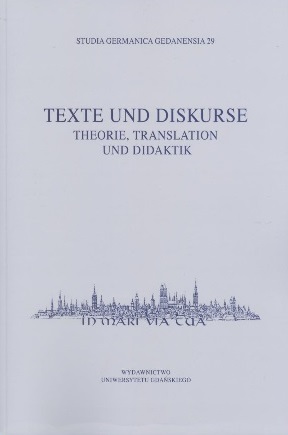
Tempuskombinationen und ihr Einfluss auf den Zeitstufenbezug der finalen deutschen Adverbialsatzgefüge im Text und im Diskurs
Słowa kluczowe:
relacje temporalne, zdania podrzędne, zdania okolicznikowe celuAbstrakt
Czasy gramatyczne i ich wpływ na odniesienia czasowe w niemieckich zdaniach okolicznikowych celu w tekście i w dyskursie
Artykuł zawiera charakterystykę względnej celowości jako formalno-funkcjonalnej kategorii składniowej. Znaczenie okolicznikowych zdań celu wynika ze współdziałania wielu środków językowych reprezentujących różne płaszczyzny językowe, tzn. płaszczyznę morfologiczną, składniową, leksykalno-semantyczną i pragmatyczną. Podstawę empiryczną stanowią przede wszystkim współczesne niemieckie teksty prasowe.
Downloads
Bibliografia
Engel, Ulrich (1988): Deutsche Grammatik. Heidelberg.
Engel, Ulrich (2009): Deutsche Grammatik. Neubearbeitung. München.
Fabricius-Hansen, Cathrine (1986): Tempus fugit. Über die Interpretation temporaler Strukturen im Deutschen. Sprache der Gegenwart 64. Düsseldorf.
Hamburger, Käte (1953): Das epische Präteritum. In: Deutsche Vierteljahrsschrift für Literaturwis‑ senschaft und Geistesgeschichte XXVII, 329–357.
Hauser-Suida, Ulrike/Hoppe-Beugel, Gabriele (1972): Die Vergangenheitstempora in der deutschen geschriebenen Sprache der Gegenwart [Heutiges Deutsch. Reihe I: Linguistische Grundlagen. Bd. 4]. München.
Latzel, Sigbert (1977): Die deutschen Tempora Perfekt und Präteritum. Eine Darstellung mit Bezug auf Erfordernisse des Faches „Deutsch als Fremdsprache“ [Heutiges Deutsch. Reihe III: Linguistisch-didaktische Untersuchungen des Goethe-Instituts. Bd. 2]. München.
Neumann, Ingrid (1972): Temporale Subjunktionen. Syntaktisch‑semantische Beziehungen im heutigen Deutsch [Forschungsberichte des Instituts für Deutsche Sprache; Bd. 11]. Tübingen.
Schulz, Dora/Griesbach, Heinz (111981): Grammatik der deutschen Sprache. Ismaning.
Thieroff, Rolf (1992): Das finite Verb im Deutschen; Tempus‑Modus‑Distanz [Studien zur deutschen Grammatik; Bd. 40]. Tübingen.
Wierzbicka, Mariola (2004): Zeitbeziehungen in den Temporalsatzgefügen erörtert an den Gegebenheiten der Consecutio Temporum im Deutschen und im Polnischen. München.
Wierzbicka, Mariola/Schlegel, Dorothee (2008): Sprechzeiten im Diskurs. Zum absoluten und relativen Gebrauch der Tempora in der gesprochenen deutschen Sprache. München.
Wierzbicka, Mariola (2013): Kausale Adverbialsätze im Deutschen und im Polnischen. München.
Opublikowane
Jak cytować
Numer
Dział
Licencja
Copyright by Instytut Filologii Germańskiej, Wydawnictwo Uniwersytetu Gdańskiego.


