Academic Scientific Journals
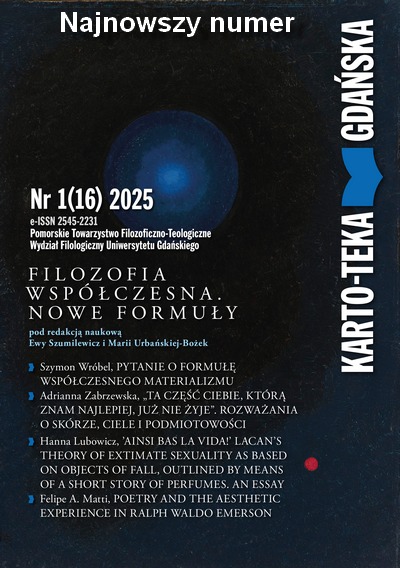
'Ainsi Bas La Vida!' Lacan’s Theory Extimate Sexuality as Based on Objects of Fall, Outlined by Means of a Short Story of Perfumes. An Essay
DOI:
https://doi.org/10.26881/kg.2025.1.03Keywords:
object a, Thing, Other, structural imitation, narcissistic imitation, smell, scent, perfumeAbstract
This paper is a trial of showing analogy between the function that ‘little objects’ perform in the vicissitudes of desire and certain important discoveries in the world of perfume industry. I make use of the Lacanian concept of imitation, in particular I discern between the structural imitation and narcissistic imitation. The latter is a sort of ‘superficial’ process based on the Imaginary, pre-Oedipal functioning of the subject, the former is a much more ‘deeper’ phenomenon that consists in such a kind of imitation that considers the essential structure determining the mechanism in question. I make a short description of the industry of composing fragrances. In the story of the business of producing scents there has been a certain breakthrough, allowing us to understand the libidinal trajectories of drive. The beginning has been the extraction of ‘escentric molecules’ by producers of perfumes. Especially, the one most worth of being interested in is the so called ‘ISO E Super’, the discovery of which has been an accomplishment achieved by Geza Schoen. On this base I make a statement that smell could function as one of ‘objects a’, as they were described in Lacan’s theory. This supposition is made due to the observation that this mysterious molecule ‘behaves’ structurally in a similar way as the essential feature accounting for the fact that ‘little objects’, especially the two ones additional conceptualized by Lacan, namely voice and gaze, play such a crucial described in the Lacanian psychoanalysis. Although any ‘little a’ seems to be sort of ‘hidden’ in the libidinal economy of the subject, its impact is enormous, as it helps a particular human being become ‘risen to the dignity of the Thing’. The ‘objects’ set in motion the whole energy of the drive that circles around these unique ‘points’ of the dynamic mechanism of desire. The specific ‘something’ that characterizes a particular personal smell hypothetically contains a kind of an ‘accountant’ of the ISO E Super, the enigmatic factor that paves the way to the recognition (not knowledge, as Lacan maintains) of the infinitely unknown Other in our neighbor.
Downloads
References
Lacan J., Écrits, W.W, Norton Company 19666.
Lacan J., Les quatre concepts fondamentaux de la psychanalyse, The seminar. Book 11 1964.
Lacan J., Encore, The seminar. Book 20 1972–1973.
Lacan J., In Le moi dans la théorie de Freud et dans la technique de la psychanalyse. The seminar. Book 2 1954–1955.
Lacan J., In Les Psychoses, The Seminar, Book 3 1955–1956.
Lacan J., L’ éthique de la psychanalyse, The seminar. Book 7 1986.
Lacan J., L’angoisse, The seminar. Book 10 1962–1963.
Lévinas E., Otherwise than Being, or Beyond Essence, Duquesne University Press 1991.