Uniwersyteckie Czasopisma Naukowe
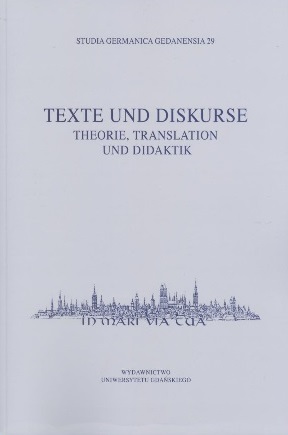
Auf der Suche nach einem tertium comparationis: Wissenschaftliche Texte im deutsch-polnischen Vergleich
Słowa kluczowe:
metajęzyk, metatekstem, akt mowy, potencjał illokucyjny, styl naukowyAbstrakt
W poszukiwaniu tertium comparationis: Teksty naukowe w niemiecko‑polskiej analizie porównawczej
Celem artykułu jest pokazanie daleko idących podobieństw w organizacji tekstów naukowych niemieckich i polskich autorów. Uchwycone zbieżności dotyczą z jednej strony strategii komunikacyjnych, polegających na budowaniu interakcji z odbiorcą, z drugiej zaś strategii kompozycyjnych, wyrażających się w dwóch przeciwstawnych sposobach budowania struktury tekstu, czyli jego delimitacji oraz łączeniu jego poszczególnych segmentów. Dostęp do obu strategii umożliwiają akty mowy, które wskazują na podobny potencjał illokucyjny tekstu naukowego i dostarczają także porównywalnych wyróżników stylu naukowego. Różnice między tekstami naukowymi wynikają z dużej swobody, jaką mają autorzy tekstów nauk humanistycznych oraz ich indywidualnych preferencji. Należy być dzisiaj bardzo ostrożnym w doszukiwaniu się różnic kulturowych i naukowych dyskursów „narodowych”.
Downloads
Bibliografia
Dietz, Gunther (2000): Titel in wissenschaftlichen Texten. In: Brinker, Klaus/Antos, Gerd/Heinemann, Wolfgang/Sager, Sven F. (Hg.): Text und Gesprächslinguistik. Ein Internationales Handbuch zeitgenössischer Forschung (HSK 16.1). Berlin, New York, 617–624.
Ehlich, Konrad (2006): Mehrsprachigkeit in der Wissenschaftskommunikation – Illusion oder Notwendigkeit? In: Ehlich, Konrad/Heller, Dorothee (Hg.): Die Wissenschaft und ihre Sprachen. Frankfurt/M., 17–38.
Fandrych, Christian/Graefen, Gabriele (2002): Text commenting devices in German and English academic articles. In: Multilingua: Journal of cross‑cultural and interlanguage Communication 21(1), 17–45.
Fix, Ulla (2001): Grundzüge der Textlinguistik. In: Fleischer, Wolfgang et.al. (Hg.): Kleine Enzyklopädie Deutsche Sprache. Frankfurt/M., 471–511.
Gajewska, Urszula (2004): Metatekstemy w języku nauk ścisłych [Metatexteme in der Sprache der Naturwissenschaften]. Rzeszów.
Göpferich, Susanne (1995): Textsorten in Naturwissenschaft und Technik. Pragmatische Typologie – Kontrastierung – Translation. Tübingen.
Graefen, Gabriele (1997): Der Wissenschaftliche Artikel – Textart und Textorganisation. Frankfurt/M.
Heinemann, Margot/Heinemann, Wolfgang (2002): Grundlagen der Textlinguistik. Interaktion – Text – Diskurs. Tübingen.
Heller, Dorothee (Hg.) (2010): Deutsch, Italienisch und andere Wissenschaftssprachen.Frankfurt/M.
Hellwig, Peter (1984): Grundzüge einer Theorie des Textzusammenhangs. In: Rothkegel, Annely/Sandig, Barbara (Hg.): Text – Textsorten – Semantik. Linguistische Modelle und maschinelle Verfahren. Hamburg, 51–79.
Kruse, Otto (1997): Wissenschaftliche Textproduktion und Schreibdidaktik. In: Jakobs Eva-Maria/Knorr, Dagmar (Hg.): Schreiben in den Wissenschaften. Frankfurt/M., 141–158.
Mautner, Gerlinde (2011): Wissenschaftliches Englisch. Stilsicher schreiben in Studium und Wissenschaft. Konstanz.
Mikołajczyk, Beata (2011): Zur Kulturbedingtheit des wissenschaftlichen Diskurses am Beispiel der Verfasserreferenz in der Textsorte ‘autographes Vorwort einer wissenschaftlichen Abhandlung’, ein deutsch-polnischer Vergleich. In: Kotin, L. Michail/Kotorova, Elizaveta G. (Hg.): Die Sprache in Aktion. Pragmatik, Sprechakte, Diskurs. Heidelberg, 175–184.
Olszewska, Danuta (2007): Metatexteme in den Geisteswissenschaften. Typologie – Funktionalität – Stilistik. Gdańsk.
Rothkegel, Annely (1993): Textualisieren. Theorie und Computermodell der Textproduktion. Frankfurt/M.
Steinhoff, Torsten (2007): Zum ich-Gebrauch in Wissenschaftstexten. In: Zeitschrift für germanistische Linguistik 35, 1–26.
Opublikowane
Jak cytować
Numer
Dział
Licencja
Copyright by Instytut Filologii Germańskiej, Wydawnictwo Uniwersytetu Gdańskiego.