Uniwersyteckie Czasopisma Naukowe
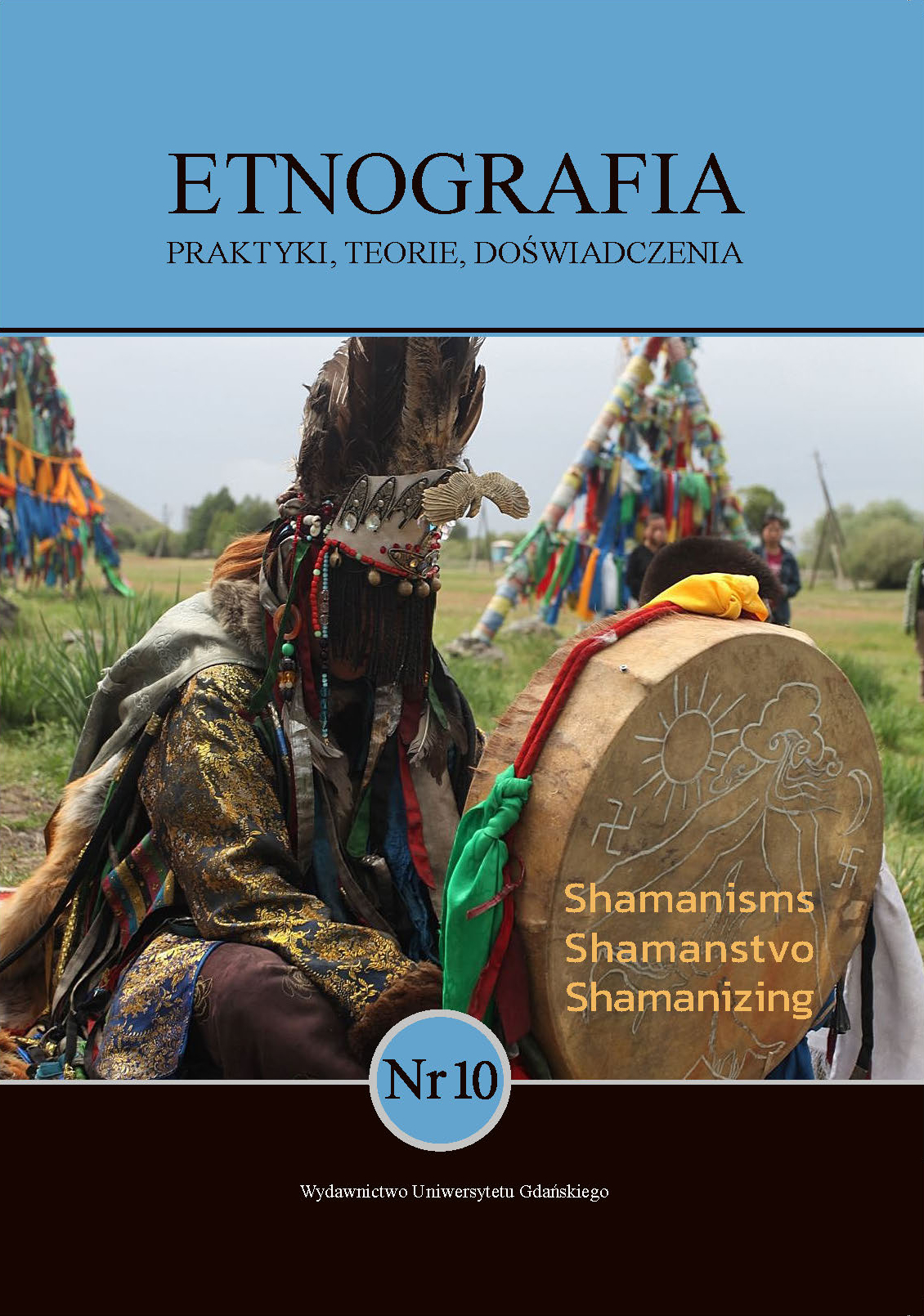
W stronę antropologii szamanizmów. Wprowadzenie do problematyki wybranych zagadnień
Toward an anthropology of shamanisms: Introduction to selected topics
DOI:
https://doi.org/10.26881/etno.2024.10.01Słowa kluczowe:
history and meanings of the term “shamanism”, shamanic studies, paradigms in shamanism studies, anthropological methodologyAbstrakt
The article provides a concise introduction to two issues in anthropological research on shamanism:
1) the conceptual use of the term “shamanism” and 2) the main methodological approaches to its study. It proposes a kind of cognitive map of shamanisms, shaped by key ideas from anthropology. The text also suggests a way to organize the extensive literature on shamanism from both paradigmatic perspectives, encompassing approaches, schools, and frameworks, and a historical perspective, considering stages, phases, and periods of research. In doing so, the article offers a structured entry point into the complex field of shamanism studies
Downloads
Bibliografia
Abramzon, S. M. (1958). K kharakteristike shamanstva v starom bytu kirgizov. Moskwa: KSIĖ.
Atkinson, J. M. ( 1992). Shamanisms Today. Annual Review of Anthropology 21, 307–330.
Banzarov, D. (1846). The black faith, or, Shamanism among the Mongols [Doctoral dissertation, Kazan University]. Uchenye zapiski Kazanskogo universiteta, Kniha III.
Basylov, V. N. (1992). Shamanstvo u narodov Srednei Azii i Kazakhstana. Moskwa: Nauka.
Boekhoven, J.W. (2011). Genealogies of Shamanism: Struggles for Power, Charisma and Authority. Groningen: Barghuis.
Bogoraz, V. G. (1919). K psikhologii shamanstva. Izvestiya Rossiyskoy Akademii Nauk, 1–27.
Bowie, F. (2008). Antropologia religii. Wprowadzenie, tłum. K. Pawluś. Kraków: Wyd. Uniwersytetu Jagiellońskiego.
Chaumeil, J.-P. (1998). Prefacio a la edición en castellano. In: Ver, saber, poder: chamanismo de los Yagua de la Amazonía peruana, transl. Mariella Villasante-de Beauvais (p. 15-38). Lima: CAAAP/IFEA/CAEA [oryg. Chaumeil, J.P. 1983. Voir, Savoir, Pouvoir. Le Chamanism chez les Yagua du Nord-est Péruvien. Paris: EHSS]
Clottes, J., Lewis-Williams, D. (2009), Prehistoryczni szamani. Trans i magia w zdobionych grotach, tłum. A. Gronowska, Warszawa: Wydawnictwa Uniwersytetu Warszawskiego.
DeMiller, A. (2002). Shamanism: A selected annotated bibliography. In: The Anthropology and Sociology Section of the Association of College and Research Libraries (ACRL). American Library Association.
Dioszegi, V. (1974). Shamanism. Encyclopedia Britannica, vol. 16, s. 638-641.
Drury, N. (1994). Szamanizm, tłum. H. Smagacz. Poznań: Rebis.
DuBois, T. A. (2009). An Introduction to Shamanism (Introduction to Religion). Cambridge: Cambridge Univ. Press.
DuBois, T.A. (2011). Trends in Contemporary Research on Shamanism. Numen, 58, 100-128.
Eliade, M. (1964). Shamanism: Archaic Technique of Ecstasy. New York: Bellingen Foundation. [przekład polski: Eliade, M.1994. Szamanizm i archaiczne techniki ekstazy, tłum. K. Kocjan. Warszawa: Wyd. PWN].
Firestone, E.R. (2016). Animism and Shamanism in Twentieth-Century Art. Kandinsky, Ernst, Pollock, Beuys. Routledge Chapman Hall (wyd. internetowe)
Geertz, C. (1966). Religion as a cultural system. [w:] M. Banton (red.), Anthropological Approaches to the Study of Religion. Tavistock: A.S.A. Monographs 3, 1-46.
Grant, B. (2021). Slippage: An Anthropology of Shamanism. Annual Review of Anthropology, 50, 9-22.
Halifax, J. (1979). Shamanic voices. A Survey of Visionary Narratives. New York: Dutton.
Hamayon, R. N. (1993/2007). Are 'Trance,' 'Ecstasy' and Similar Concepts. Appropriate in the Study of Shamanism? Shaman 1(2): 3‐25.
Hamayon, R. N. (1998). ‘Ecstasy’ or the West-Dreamt Siberian Shaman. In: H. Wautischer (ed.), Tribal epistemologies. Essays in the philosophy of anthropology. London, New York: Routledge, 175-187.
Hamayon, R. N. (2001). Shamanism: Symbolic system, human capability and Western ideology. [w] H.-P. Francfort, R. Hamayon, P. G. Bahn (red.), The concept of shamanism: Uses and abuses. Budapeszt: Akadémiai Kiadó, 1-27.
Harvey, G., Walls, R. J. (2007). Historical Dictionary of Shamanism. Lanham, Toronto, Plymouth: The Scarecrow Press, Inc.
Holbraad, M., Pedersen, M. A. (2017). The ontological turn: An anthropological exposition. Cambridge: Cambridge University Press.
Hoppál, M. (2009). Szamani eurazjatyccy, A. Barszczewska (tłum.). Warszawa: Iskry.
Humphrey, C., Onon, U. (1996). Shamans and elders: Experience, knowledge and power among the Daur Mongols. Oxford University Press.
Hutton, R. (2001). Shamans: Siberian Spirituality and the Western Imagination. Hambledon and London.
Kalweit, H. (2000). Shamans, healers, and medicine man, transl. M. H. Kohn. Boulder: Shambhala Publication Inc.
Kehoe, A. B. (2000). Shamans and Religion: An Anthropological Exploration in Critical Thinking. Illinois: Long Grove.
Korzenevskii, N. O. (1913). O shamanstve u alaiskikh kirgiz. Turkestanskie Vedomosti, 31.
Langdon, E. J. (2017). Cosmopolitics among the Siona: shamanism, medicine and family on the Putumayo River. Popayán: Universidad del Cauca.
Lot-Falk, E. (1963). A propos du terme chamane. Etudes Mongoles et Siberiennes, 1977, 8, 7-18.
Malov, S. E. (1912). Ostatki shamanstva u zoltykh ujgurov. Zapiski Vostochnogo Otdeleniya Russkogo Arkheologicheskogo Obshchestva, 19, 1–15.
Mikhaylovskiy, V. M. (1892). Shamanstvo: Sravnitel'no-etnograficheskiye ocherki. Moskwa: Etnograficheskoe otdeleniye Moskovskogo universiteta.
Narby, J. (2014). Kosmiczna spirala. Przekazywanie wiedzy za pośrednictwem DNA. Białystok: Studio Astropsychologii.
Narby, J., & Huxley, F. (Eds.). (2001). Shamans through time: 500 years on the path to knowledge. New York, NY: J. P. Tarcher/Putnam.
Pedersen, M. A., Empson. R., Humphrey, C. (eds). (2007). Editorial Introduction, Inner Asian Perspectivisms. Inner Asia, 9 (2), 141–152.
Pedersen, M. A. (2011). Not Quite Shamans: Spirit Worlds and Political Lives in Northern Mongolia. Ithaca, NY: Cornell Univ. Press
Połeć, W. (2016). Ubierając się dla duchów. O roli płci (kulturowej), transwestytyzmu i cielesności w rytuałach szamańskich, Dyskursy Młodych Andragogów, nr 17, s. 371-385.
Pollock, D. (2019). Shamanism. Oxford Bibliographies. https://doi.org./10.1093/OBO/9780199766567-0132
Pratt, Ch. (2007). An Encyclopedia of Shamanism. Vol. I i II. New York: The Rosen Publishing Group.
Price, N.S. (ed.) (2001). Archaeology of Shamanism. London, New York: Routledge.
Reichel-Dolmatoff, G. (1975). The shaman and the jaguar. A study of narcotic drugs among the Indians of Colombia. Philadelphia: Temple University Press.
Rogers, S. L. (1982). The shaman: his symbols and his healing powers. Illinois: Charles C. Thomas, Springfield.
Shirokogorov, S. M. (1919). Opyt issledovaniya osnov shamanstva u tungusov. Uchyonyye zapiski istoriko-filologicheskogo fakul'teta. 1.
Shirokogoroff, S. M. (1935). Psychomental complex of the Tungus. London: Kegan Paul.
Stutley, M. (2003). Shamanism. An introduction. London, New York: Routledge.
Szyjewski, A (2005). Szamanizm. Kraków: WAM.
von Stuckrad, K. (2002). Reenchanting nature: Modern Western shamanism and nineteenth-century thought. Journal of the American Academy of Religion, 70(4), 771–799. https://doi.org/10.1093/jaarel/lfv027
Taussig, M. (1987). Shamanism, Colonialism, and the Wild Man: A Study in Terror and Healing. Chicago: University of Chicago Press.
Tedlock, B. (2001). The woman and shaman’s body: reclaiming the feminine in religion and medicine. New York: Bantam Books.
Tsintsius, V. I. (1975). Comparative Dictionary of the Tungusic-Manzhur Languages. Leningrad: Nauka.
Vainshtein, S. I. (1964). Tuvinskoe shamanstvo. Moskwa: Nauka.
Vitebski, P. (1996). Szaman, tłum. Z. Dalewski. Warszawa: Świat Książki
Znamenski, A. (2007). The Beauty of the Primitive: Shamanism and Western Imagination. Oksford: Oxford University Press.
Walter, M. N., Fridman, E.J.N. (eds.) (2004). Shamanism: an encyclopedia of world beliefs, practices, and culture. Vol. I i II. Santa Barbara, CA & Oxford: ABC Clio.
Walsh, R. (2007). The World of Shamanism: New Views of an Ancient Tradition. Llewellyn Publications.
Wasilewski, J.S. (1979). Podróże do piekieł. Rzecz o szamańskich misteriach. Warszawa: Ludowa Spółdzielnia Wydawnictwa.
Wierciński, A. (1994). Model postaci szamana, In: A. Wierciński, Magia i religia. Szkice z antropologii religii, s. 153-185. Kraków: Nomos.
Willerslev, R. (2007). Soul hunters: hunting, animism, and personhood among the Siberian Yukaghirs. Berkeley: University California Press
Winkelman, M. (2010). Shamanism: A biopsychosocial paradigm of consciousness and healing. Santa Barbara, Denver, Oxford: ABC-CLIO/Praeger Press.
Opublikowane
Jak cytować
Numer
Dział
Licencja
Czasopismo wydawane jest na licencji Creative Commons Uznanie autorstwa-Na tych samych warunkach 4.0 Międzynarodowe.